
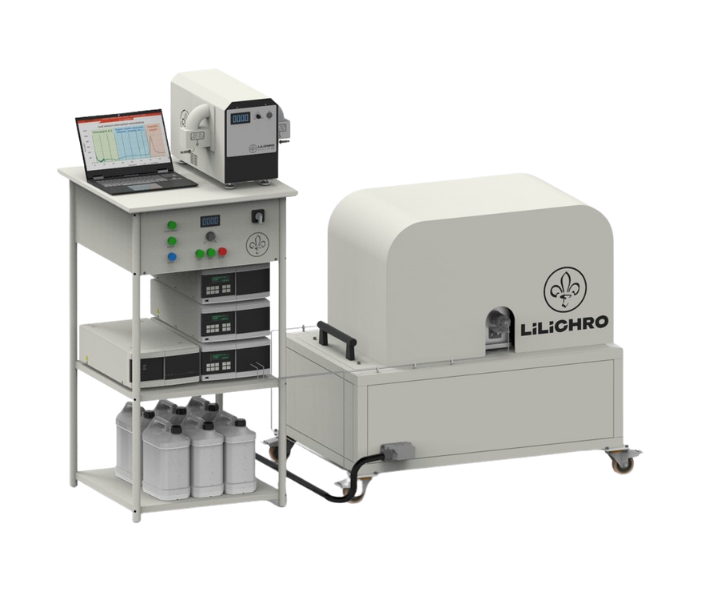
What is Liquid-Liquid chromatography?
Liquid-liquid chromatography technology effectively combines extraction and chromatography as a common solution. Because it uses a liquid stationary phase, liquid-liquid chromatography offers many advantages over traditional liquid-solid chromatographic separation techniques, like HPLC. These include high sample loading capacity and the possibility of lossless sample recovery.
Advantage of liquid-liquid chromatography technology
Preparative LC challenge
-
Stationary phase regeneration
-
Scale up (column shapes, silica gel and solvents – so everything – are different)
-
Time consuming and expensive development: • Silica gel tests from different manufacturers • Run to run solvent system optimalisation
LLC solution
-
Both phases are liquid, simple distillation
-
Simple multiplication: • Loading is same • n [1/min] relies on r [m] • Linear scale up
-
Short development time • Find an optimal biphasic solvent system. Vial test by HPLC or TLC – 1-3 day • Finetuning with miniLiLi – 1 week
LiLiCHRO devices do this in a highly efficient way


They can be used for a very large number of target components and can be optimised for a wide range of different operating modes. It can be used as a basis for laboratory technologies and scientific and academic research and applications that can extend the application of these devices far beyond the laboratory. To this end, LiLiCHRO is committed to working with its partners.
What is the difference between HPLC, Flash Chromatography and Liquid-Liquid Chromatography?
Technical & operational comparison
| Metric | HPLC | Flash Chromatography | Liquid-liquid Chromatography |
|---|---|---|---|
| Separation principle |
Solid-liquid Adsorption or partitioning on a packed solid column. |
Solid-liquid Adsorption on silica or another disposable packed medium. |
Liquid-liquid Partitioning between two immiscible liquid phases. |
| Product recovery | Possible losses from irreversible adsorption on solid media. | Possible losses due to adsorption, broad bands, and cartridge retention. | Very high; the liquid stationary phase can be flushed out after the run. |
| Consumables cost | High; preparative columns and resins are recurring expenses. | High; cartridges and silica are consumed continuously. | Low; no silica, no resin bed, no disposable column. |
| Waste profile | Solvent waste plus spent columns or resin replacement. | High solvent and silica waste. | No solid stationary-phase waste; compatible with solvent recovery and recycling. [GREEN] |
| Scale-up predictability | Often empirical and column-dependent. | Limited; mainly suited for lab and early preparative work. | More linear; based on phase ratios, rotor volume, flow rate, and loading. |
| Best use case | Final polishing of APIs, analytical methods, and high-resolution separations. | Fast purification of synthetic intermediates in R&D. | Crude natural products, cannabinoids, peptides, complex extracts, and high-recovery purification. |
What are the advantages of having a LiLiCHRO device?
LiLiCHRO’s devices provide one of the best value for money solutions to various cleaning and separation problems.
The LLC, in a unique way in chromatography, is very easy to scale up (unlike prepLC). On several occasions we faced problems where we had very little amount of material available.
With the smallest device available for Laboratory, 1-2 g of sample is needed for a feasibility study.
The LiLiCHRO, and the world’s smallest instrument, works with a miniLiLi 20 ml cell volume and a flow rate of 1-2 ml/min, and is therefore often comparable to a conventional analytical HPLC. This is a big step forward for LLC.
Our preparative LLC equipment, on the other hand, has a cell volume of 100 litres – five times larger than the largest unit ever created. The completely redesigned cell system has also greatly increased efficiency, raising the monthly purifiable volume to 0.5-2 T.
Want to know more about our products? Discover our product portfolio.

Featured Article:
Centrifugal Partition Chromatography, and Why Purification Labs Are Paying Attention
LCGC International
Chromatography Online explores the growing adoption of Centrifugal Partition Chromatography (CPC) in modern laboratories. Read how this liquid-liquid technique eliminates solid stationary phases, reduces solvent consumption, and streamlines complex separation processes.
The perpetual development of the LiLiCHRO
Industrial new cells
The reinvented cell design has increased efficiency by an order of magnitude compared to the old cells.
Industrial new rotor
Due to the redesigned rotor structure, the pressure drop in the device has been greatly reduced, so the pressure drop of 50-100 bar that was previously experienced, is only 10-30 bar on the new rotor.
Industrial new rotary-union
The constant need for seal replacement has been eliminated.
Industrial new mixer-settler
Two-phase production is always a challenge on an industrial scale. A two-phase system must first be mixed and then separated in order to start the separation process. At a flow rate of 20 l/min we had to rethink this process as well. We are proud that the new system is capable of feeding the unit continuously and safely.
LiLiChro LLC Scale-Up Pathway
One technology platform from method development to industrial purification
Method development
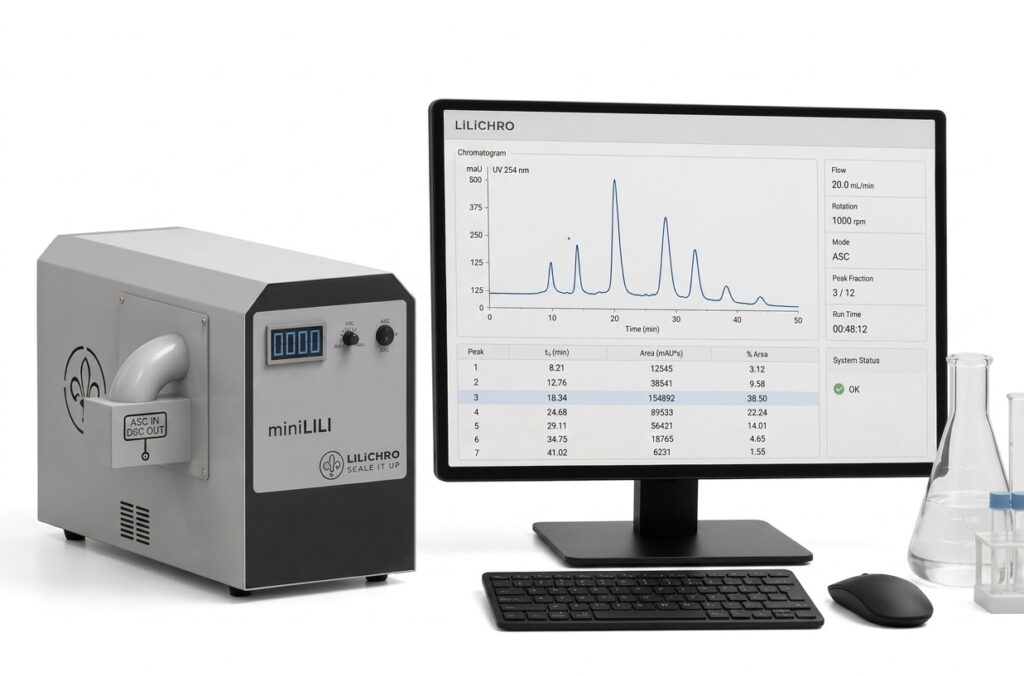
miniLiLi
Sample amount
1–200 mg
Typical use
Method development, analytical applications, micro-preparations
Scale-up role
Develop and optimize the CPC method with low solvent consumption
Lab prep
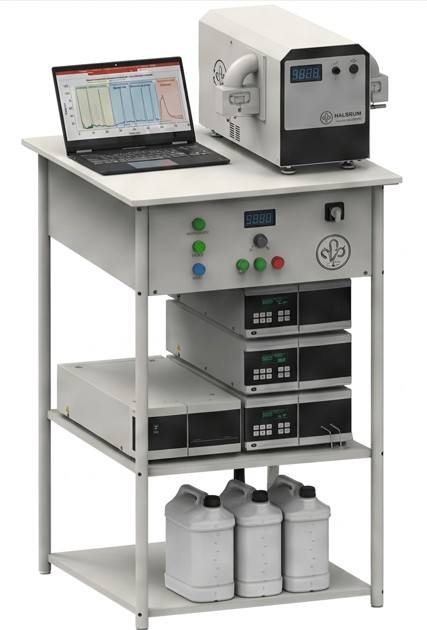
midiLiLi
Sample amount
1–2 g
Typical use
Laboratory preparations, standards, replacing flash chromatography
Scale-up role
Bridge from method development to gram-scale purification
Pilot scale
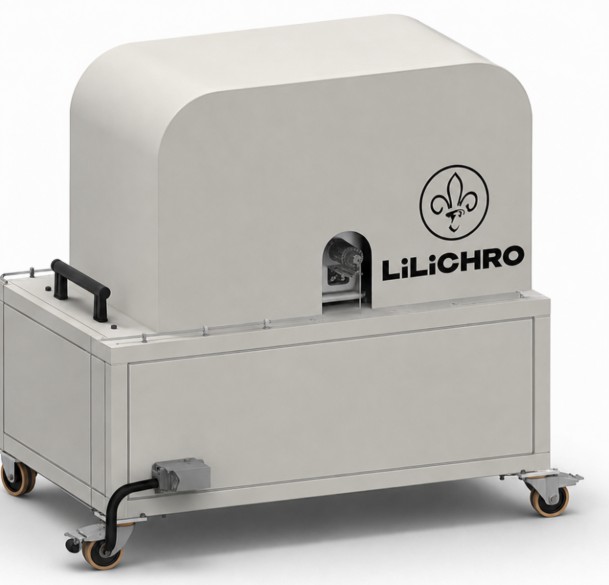
maxiLiLi
Sample amount
100–150 g
Typical use
Pilot production, small pilot batches
Scale-up role
Scale validated methods to pilot-scale throughput
Industrial purification

prepLiLi
Sample amount
2–3 kg
Typical use
Continuous high-volume industrial chromatography
Scale-up role
Industrial purification and production-scale implementation
Want to talk to LiLiCHRO?